How much light do we want to let into a room? Do we want to shield ourselves from outside eyes, keep out direct sun, or be able to make the room dark when we need to?
Choosing curtains often begins with the fabric, the colour and the effect we want to create in the room. But at a window another factor comes into play: the way we want to manage light through the different hours of the day. This is where it becomes important to distinguish between filtering, blacking out and shading – three functions that may seem similar, but that answer very different needs.
There is no single way to protect a window
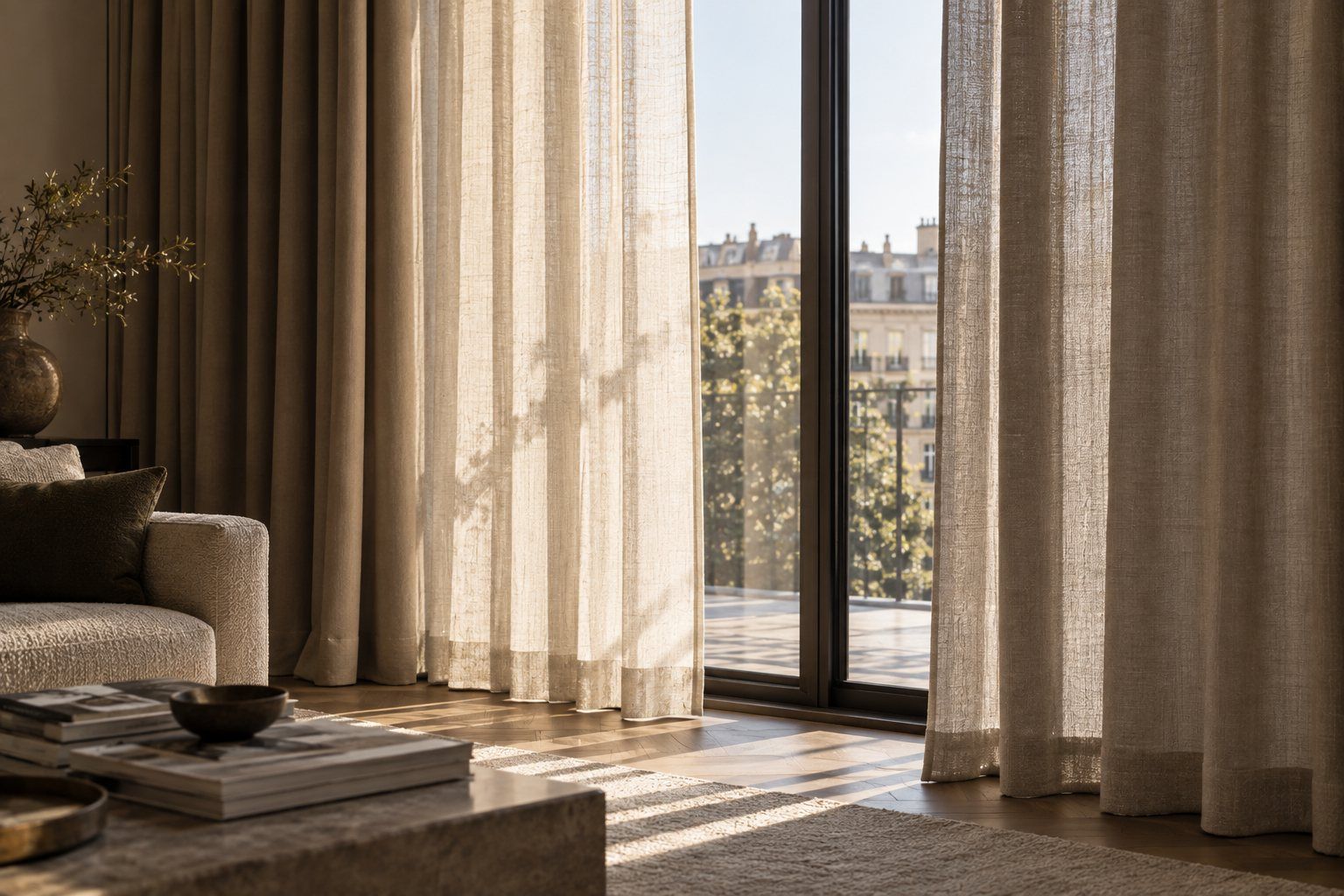
Think of a living room with a large expanse of glazing. During the day we may want to keep it bright, while avoiding light that is too direct and creating more privacy. Here there is no need to shut the light out: what is needed is to filter it. That is exactly how a light-filtering fabric works. Light still passes through it, but it is softened and diffused across the room. The result varies a great deal with the construction of the fabric: an open weave lets more of the outside world show through, while a denser structure creates a more marked separation.
Move into a bedroom and the need may be entirely different. Here it can become important to drastically reduce the light coming in, especially in the early hours of the morning, or at night when there is outdoor lighting. This is what we mean by blackout. A blackout fabric is made to restrict the passage of light severely, but the final result does not depend on the fabric alone. Even a small gap at the side can let light in, so tracks, dimensions, making-up and installation all become part of the solution. In other words, choosing a blackout material is not enough to achieve a good blackout. Everything around it has to be properly designed.
And when the problem is the sun?
Then there is a different situation: a window with strong exposure, especially at the hours when the sun strikes the glass directly. Here blacking out and shading are not the same thing.
Solar shading is designed to act on the relationship between a building and solar radiation, helping to limit glare and solar gain through glazed surfaces. Its effectiveness depends on the material, the characteristics of the system, the glass and also the position of the shading. This matters particularly when working with large areas of glazing, where controlling the sun can become a genuine design requirement.
And this is precisely where it becomes clear why a solution may have more than one layer.
Shading can take care mainly of sun protection, while curtains on the inside handle light, privacy and atmosphere. Or a blackout system can sit alongside a lighter curtain used during the day. It is not necessarily a matter of choosing one solution over another, but of understanding which functions need to coexist at the same window.
Light changes, and curtains should follow it
A room is not always lived in under the same conditions. Light at nine in the morning is not the light of the afternoon. Exposure changes from one façade to another, just as needs differ between a bedroom, a living room, a study or a room that looks directly onto another building. That is why two apparently identical windows may call for entirely different solutions.
Before even choosing a fabric, then, it is worth observing the room: where does the sun come from, at what times, how much privacy is needed and how much light do we want to keep?
Only then do filtering, blacking out and shading stop being three technical terms and become three design tools.
Because designing curtains is not simply about dressing a window. It is about deciding how that window should behave over the course of the day.