When we choose a mattress, our attention almost always goes to the most immediate sensations: how soft it is, how much support it gives, how it cradles the body. But there is a less visible aspect that matters just as much: the materials it is made from.
Through the night, the body goes on producing heat and giving off moisture. The mattress is therefore not a passive surface: it helps to create the microclimate in which we spend many consecutive hours. It is precisely within this balance that natural fibres can make a difference.
Comfort is not only a question of softness
Wool, cotton, silk and other fibres of natural origin have long been used in the making of bed systems, for qualities that go beyond simply being pleasant to the touch.
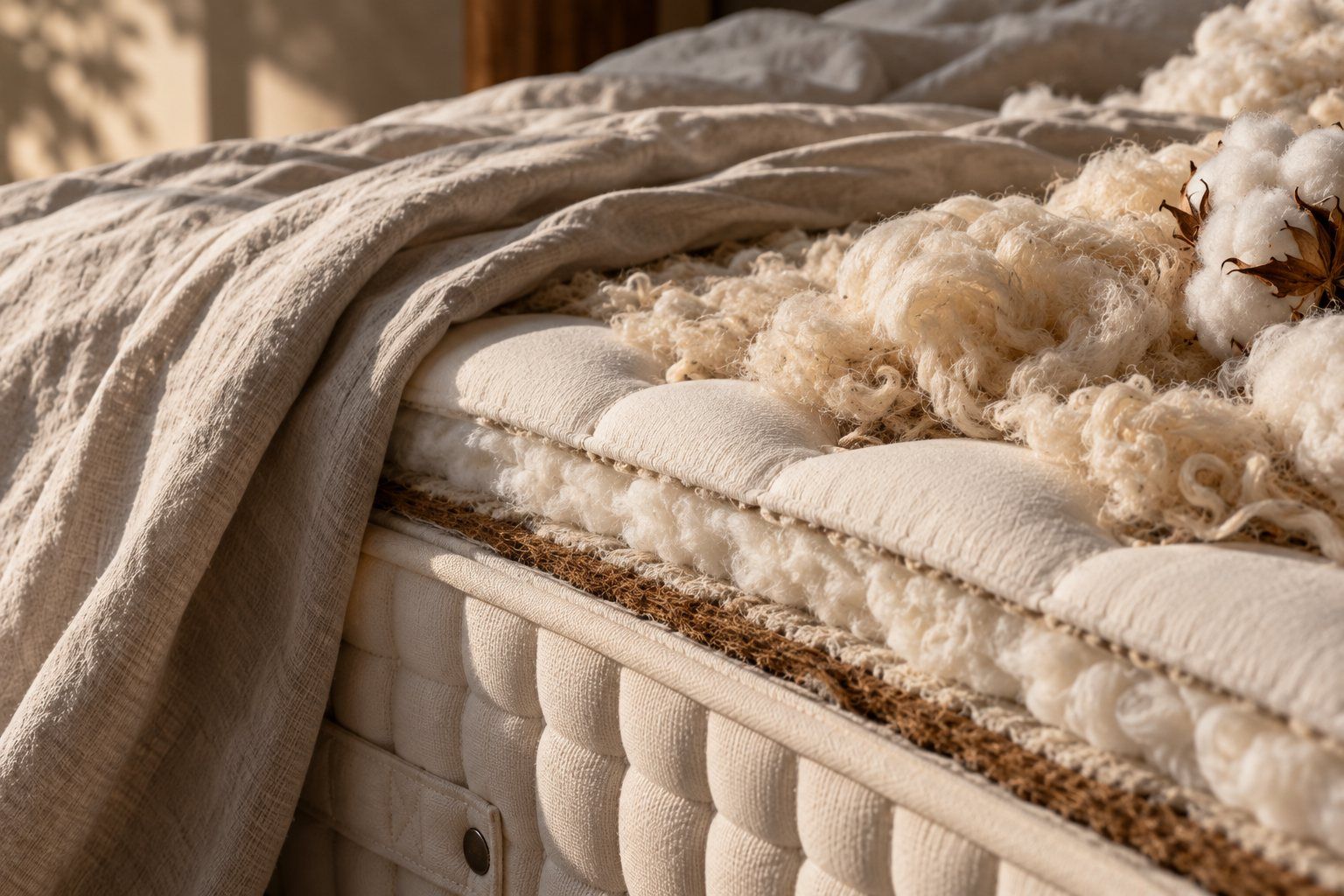
Their structure allows them to interact naturally with heat and moisture, encouraging a more breathable environment and helping the body to stay comfortable through the night. Wool, for example, is particularly valued for its ability to absorb water vapour and release it gradually, helping to regulate the microclimate without creating the damp feeling that can disturb comfort.
Cotton and silk, for their part, bring different properties. And it is precisely the combination of fibres, more than the presence of any single material, that determines how the mattress behaves overall.
A material that works with the body
Thinking about a natural mattress therefore means going beyond the often simplistic idea that “natural” is automatically synonymous with better.
What makes the difference is the quality of the raw materials, where they come from, how they are selected and worked and, above all, how they are used within the structure of the mattress.
A well-designed system brings fillings, springs, covers and workmanship into play together, so that each element performs a precise function. Natural fibres thus become part of a more complex balance, conceived to accompany the body and to manage the changes in temperature and humidity that occur over the course of the night.
It is a conception of comfort that is less immediately visible, but easy to sense when you try a mattress built with particular attention to its materials.
From the choice of fibres to the making of the mattress
This same attention also lies at the heart of the tradition of Hypnos, the long-established British maker of handcrafted beds and mattresses, which uses selected natural fibres in its collections and combines different materials within its fillings.
Wool, cotton and other fibres are chosen not only for their fineness, but for the role they can play within the bed system. It is an approach in which raw material and construction are closely bound together, and in which comfort comes from the whole rather than from any single component. That is why knowing what lies inside a mattress can also change the way you choose one. It does not necessarily mean seeking out the rarest material or the richest composition, but understanding which balance best suits your body and the way you sleep.
A specification sheet can tell you a great deal about a mattress. The real test, though, remains the moment when materials, support and that cradling feel stop being characteristics on paper and become a personal sensation.